Nannofossils
Calcareous nannofossils
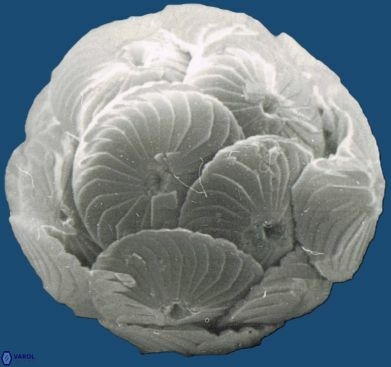
Calcareous nannofossils are microscopic, calcite-secreting planktonic algae known as coccolithophores. These marine unicellular flagellate phytoplankton belong to the domain Eukaryota, kingdom Protista, phylum (division) Haptophyta, and class Coccolithophyceae. In addition to coccolithophores, calcareous nannofossils also include associated nannoliths—calcareous structures of comparable size—such as the possibly related discoasters and schizosphaerellids, as well as unrelated forms such as the pithonellids. Only calcifying organisms bearing organic body scales and two equal flagella are classified within the Coccolithophyceae. A distinctive feature of these organisms is the haptonema, a unique organelle capable of coiling.
The informal term nannoplankton (derived from the Greek prefixes nano- and nanno-, both meaning “dwarf”) was introduced by Lohmann (1908) to describe plankton ranging from 5 to 50 µm in size. Modern usage, however, generally defines nannoplankton as plankton smaller than 63 µm, corresponding to organisms capable of passing through the finest plankton nets. While the prefix nano- is now widely used in technology and physics, nanno- remains the preferred form in biological and palaeontological terminology.
The term coccoliths was introduced by Huxley (1858), who first recognised these structures in marine sediments.
Life Cycles
Coccolithophores exhibit an alternation between diploid and haploid phases in their life cycle, commonly referred to as a dimorphic life cycle. Parke & Adams (1960) first proposed that holococcoliths and heterococcoliths may represent different stages in the life cycle of the same species, an interpretation later supported and expanded by subsequent studies (e.g., Rowson et al., 1986). This discovery significantly advanced understanding of coccolithophore biology by demonstrating that forms previously regarded as separate species may instead represent discrete life-cycle stages of a single organism.
Coccolithophores reproduce asexually through mitosis, during which one diploid cell divides to form two genetically identical diploid cells. They may also undergo meiosis, producing four haploid daughter cells, each containing a single copy of each chromosome. During the haploid phase, coccolithophores can reproduce both asexually and sexually; fusion of two haploid cells restores the diploid stage, completing the life cycle.
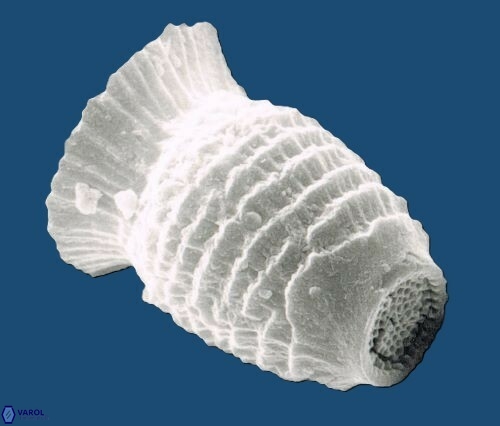
The non-motile diploid phase produces heterococcoliths composed of radially arranged calcite segments organised into complex structures. In contrast, the motile haploid phase produces holococcoliths, which consist of minute calcite crystallites—typically rhombohedral crystals or hexagonal prisms—commonly less than 0.1 µm in size. The terms holococcolith and heterococcolith were introduced by Braarud et al. (1955).
During the motile phase, coccolithophore cells possess two flagella and a haptonema, whereas these structures are absent during the alternating non-motile phase. Coccolith formation differs markedly between life-cycle stages. Heterococcoliths are produced intracellularly within Golgi-derived vesicles, allowing strong biological control over coccolith morphology. They consist of relatively large calcite elements arranged in intricate patterns, including laths, bars, wedges, and plates, assembled within predefined circular or elliptical frameworks to produce highly elaborate structures (Varol, 2025a).
In the haploid phase, cells may be naked or bear holococcoliths. Holococcoliths were traditionally interpreted as forming extracellularly with limited biological control over crystal growth, although Meyer & Taylor (2025) demonstrated that their formation may also occur intracellularly. Compared with heterococcoliths, holococcoliths exhibit simpler architectures composed of uniform calcite crystallites bound by an organic matrix. These crystallites are typically rhombohedral or hexagonal in form (Black, 1963; Gartner & Bukry, 1969; Kleijne, 1991), a microcrystalline structure most clearly observed using electron microscopy. Under cross-polarised light (XPL), hexagonal prisms and rhombohedral crystals can be distinguished optically: the optical axis is parallel to the length of the hexagonal prism but oblique in the rhombohedral crystal (Varol, 2025a).
During transitions between life-cycle stages, coccolithophores may produce combination coccospheres containing both holococcoliths and heterococcoliths. Identification and classification of holococcoliths, particularly in older sediments, remain challenging owing to their small size, simple morphology, and susceptibility to diagenetic alteration.
Brief Geological History of Nannofossils
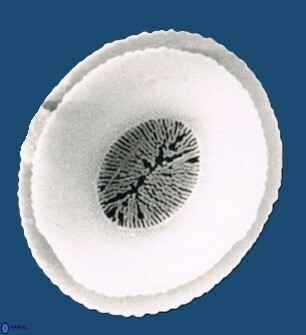
Nannofossils first appeared in the Late Triassic, apparently confined to low latitudes. They flourished in all marine environments during the Jurassic and Cretaceous and attained their maximum diversity peak during the Late Cretaceous. Nannofossils had a mass extinction at the Cretaceous/Tertiary boundary when over 90% of species became extinct. During the Early Paleocene, nannofossils re-established rapidly and reached another maximum peak in the Lower Eocene, especially at Zone NP12. Nannofossil diversity drastically reduced during the Oligocene but flourished again during the Miocene to Pliocene., followed by a significant reduction in diversity during the Pleistocene.