Senelia perifanos
Set number: 2599
-
1
-
2
-
3
-
4
-
5
-
6
-
7
-
8
-
9
-
10
-
11
-
12
10µm
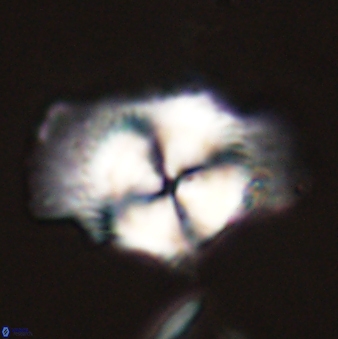
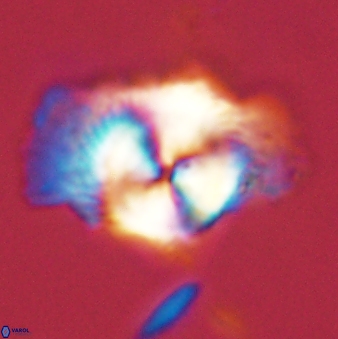
Holotype in the mobile mount.
Set number: 2600
-
1
-
2
-
3
-
4
10µm
Set number: 2601
-
1
-
2
-
3
-
4
-
5
-
6
-
7
-
8
10µm
Set number: 2602
-
1
-
2
-
3
-
4
10µm
Senelia perifanos Varol, 2023
A large (9.0–15.0 μm) species of Senelia consisting of a non-birefringent lenticular distal shield, a birefringent tube cycle and an appressed proximal shield.
From the Greek perifanos, proud – refers to its proud appearance in side view.
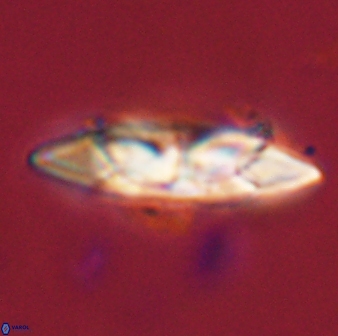
The diameter of the distal shield = 13.22μm, the thickness of the distal shield: 3.27 μm, the diameter of the tube cycle: 7.66 μm, the diameter of the proximal shield: 6.99 μm (all measured in side view in cross-polarised light with a gypsum plate).
The number of segments that construct the distal shield is between 26 and 40. The tube cycle and the proximal shield create a wide X-shaped structure in the side view. The tube cycle is flush with the distal end of the distal shield, and its diameter is at least twice that of the width of the shield.
In cross-polarised light, Senelia perifanos displays inclined laevogyre extinction lines on the distal side (Plate 16, Figs. 10 in Varol, 2023). In contrast, it displays inclined dextrogyre extinction lines on the proximal side. With the gypsum plate inserted, the blue sectors aligned to the horizontal axis on the distal side (Pl 16, Figs. 10,14,18 in Varol, 2023). In contrast, the blue sectors aligned with the vertical axis on the proximal side. The entire species appears birefringent, and the distal shield displays pointed ends in side view.
In plan view, Senelia perifanos is distinguished from Senelia plevrotos by having a much wider smooth tube cycle (diameter is twice the width of the shield). The tube cycle in Senelia plevrotos has a distinctly serrated margin, and its diameter is about equal to the width of the shield. In the side view, the distal shield has pointed ends in Senelia perifanos, whereas the distal shield has rounded ends in Senelia plevrotos.
Senelia perifanos differs from the species of Noelia by lacking a distally protruding tube cycle above the distal shield. Senelia perifanos is distinguished from Davidbukrya and Carlamuelleria by having an appressed proximal shield. Davidbukrya has no proximal shield, and Carlamuelleria has a vestigial, diminutive proximal shield.
The spaced proximal shield is present in Coccolithus formosus, Markalius astroporus and Mauriceblackia media. In Senelia perifanos, the appressed proximal shield is reduced and restricted to the inner perimeter of the distal shield.
Varol, O. 2023. New paleocene calcareous nannofossils: Carlamuelleria, Davidbukrya, Mauriceblackia, Noelia and Senelia. Marine Micropaleontology. 180: 1-41.
Holotype

Senelia perifanos
Varol, 2022
Late Paleocene
Santos Basin, Brazil