Helenea chiastia
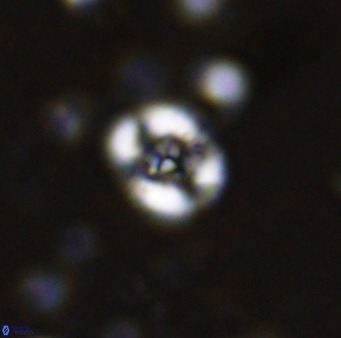
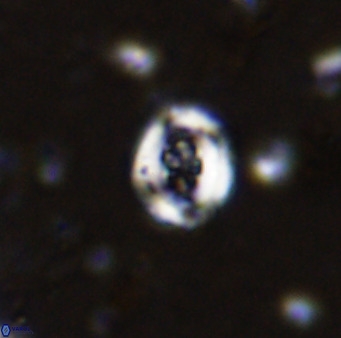
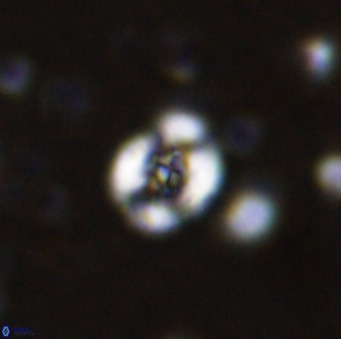
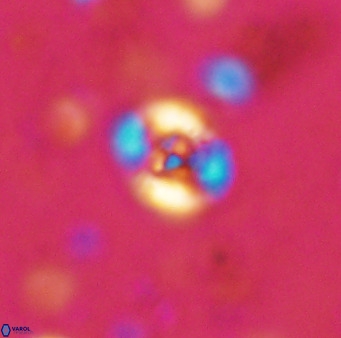
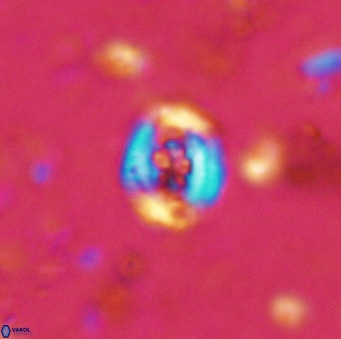
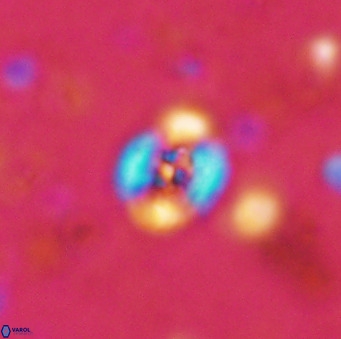
Helenea chiastia Worsley, 1971
Microstaurus quadratus Black, 1971a
Microstaurus pusillus Black, 1972a
Calculated length: 5.03 µm; ellipticity: about 2.7
Small (< 6.0 µm), normally elliptical species (ellipticity 1.2–1.3) of Helenea are characterised by an axial cross that may be slightly rotated relative to the axis of the placolith. The arms of the cross have bifurcated terminations and support a short distal process with a distinct square-shaped termination.
Optical properties consistent with those of Helenea.
Helenea chiastia differs from Helenea staurolithina in that it is smaller than 6.0 µm. Worsley (1971) noted in the remarks section for Helenea staurolithina that “H. staurolithina is differentiated from H. chiasta by its larger size and greater number of elements in the distal rim”. However, the number of segments (elements) cannot be accurately determined using the light microscope.
Black, M. 1971a. Coccoliths of the Speeton Clay and Sutterby Marl. Proceedings of the Yorkshire Geological Society 38: 381-424.
Black, M. 1972a. British Lower Cretaceous Coccoliths. I-Gault Clay (Part 1). Palaeontographical Society Monograph. 126: 1-48.
Worsley, T. R., 1971. Calcareous nannofossil zonation of Upper Jurassic and Lower Cretaceous sediments from the Western Atlantic. In: Farinacci, A. (ed.), Proceedings of the Second Planktonic Conference Roma 1970. Edizioni Tecnoscienza, Rome vol. 2, pp. 1301-1321.
Holotype
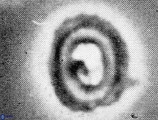
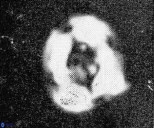
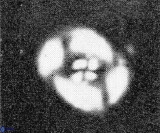
Helenea chiastia
Worsley, 1971
Berriasian - Valanginian
JOIDES, DSDP, Leg 1, hole 4, Caribbean Sea.