Helenea incompta
Retecapsa incompta Bown & Cooper, 1989b
The placolith comprises a cretarhabdid pelaga distinctly sloping towards the central area and formed of inclined segments that are typically non-imbricate, though rarely weakly clockwise-imbricate, and a central area characterised by an axial cross supporting a solid distal process. The axial cross is composed of three rows of segments, the median row being markedly narrower. The longer arms of the cross terminate in bifurcations without forming pores.
The placolith generally displays first-order, slightly greyish-white interference colours; however, it becomes dim towards the periphery, where the inner layer of the distal shield is well exposed and in constant extinction. In plan view under crossed polars, the outer layer of the distal shield exhibits inclined extinction and length-fast (–) elongation. In the axial cross, the narrow median segments are in constant extinction, whereas the adjacent segments display white interference colours.
This species is transferred to Helenea, as it possesses a cretarhabdid pelaga with an axial cross but lacks an intercross structure, consistent with the diagnosis of Helenea.
Bown, P. R. & Cooper, M. K. E. 1989b: New calcareous nannofossils from the Jurassic. Journal of Micropalaeontology 8: 91-96.
Holotype
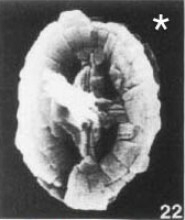
Retecapsa incompta
Bown & Cooper, 1989b
Aalenian
Brenha, Portugal.