Retecapsa primitiva
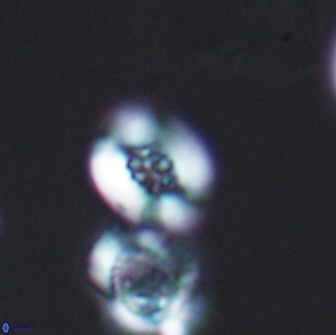
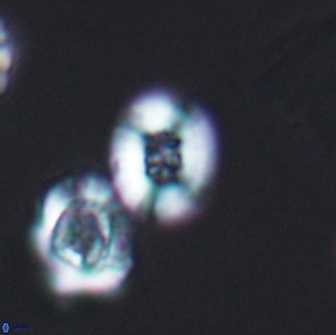
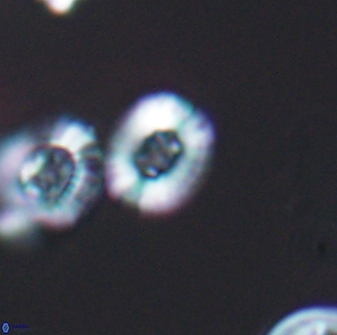
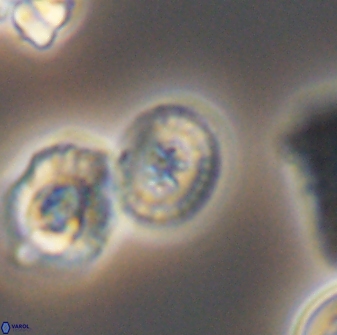
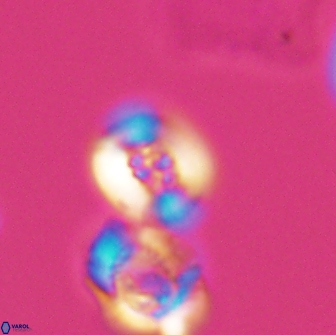
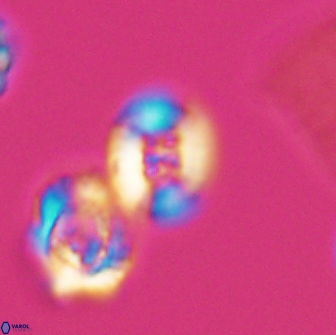
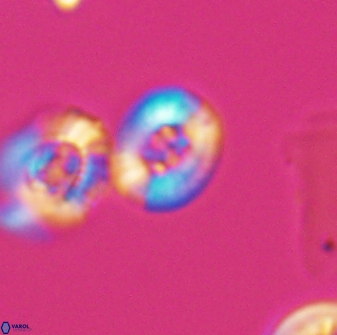
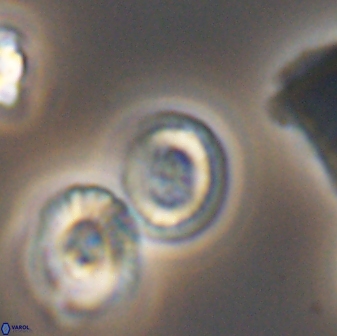
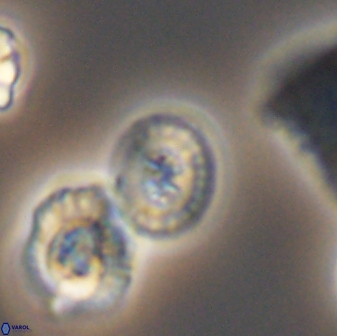
Heterorhabdus primitivus Perch-Nielsen, 1973; p. 316, pl. 1, fig. 8 (holotype); non-pl. 1 fig. 3; pl. 10, figs. 39-40.
Species of Retecapsa comprise a cretarhabdid pelaga sloping towards the central area, composed of inclined segments that are typically weakly clockwise-imbricated, but occasionally non-imbricate, and a distally arched central area lacking both an axial cross and a distal process.
The central area is narrow and lacks an axial cross and a distal process. Proximally, axially aligned elements occupy the median portion of the central area. Approximately eight closely spaced lateral bars are present; they are irregularly arranged and may define very narrow pores, which are resolvable only under bright-field and phase-contrast illumination.
Optical properties consistent with those of Retecapsa.
Retecapsa primitiva differs from Retecapsa ficula in having approximately eight lateral bars in the central area, whereas the latter has approximately twelve lateral bars.
Perch-Nielsen, K., 1973a. Danian and Campanian/Maastrichtian coccoliths from Nugssuaq, West Greenland. Bulletin of the Geological Society of Denmark. 22, 79-82.
Stover, L. E. 1966. Cretaceous coccoliths and associated nannofossils from France and the Netherlands. Micropaleontology 12(2): 133-167.
Holotype
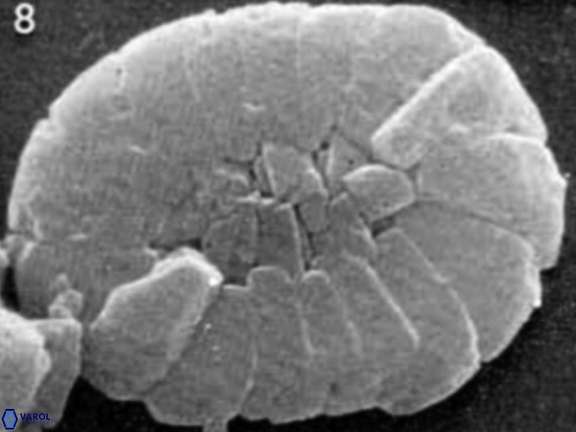
Heterorhabdus primitivus
Perch-Nielsen, 1973
Maastrichtian
Majunga Basin, Madagascar