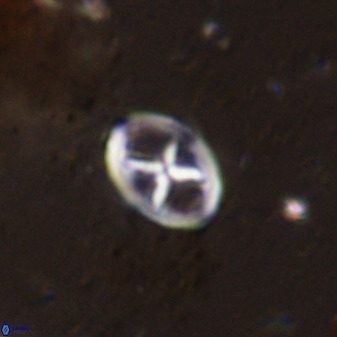
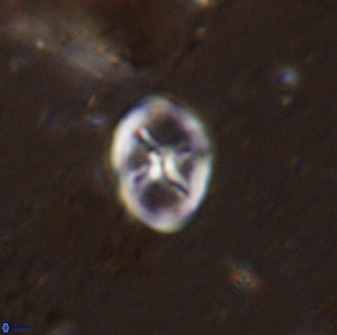
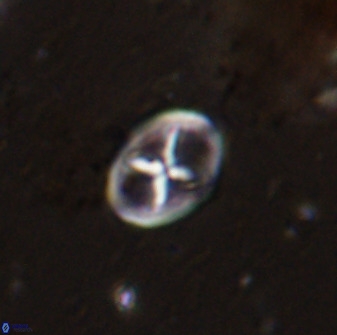
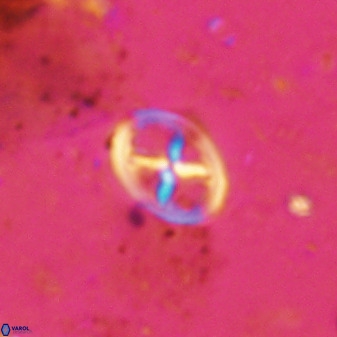
Chiastozygus amphipons
Set number: 2909
-
1
-
2
-
3
-
4
-
5
-
6
-
7
-
8
-
9
-
10
-
11
-
12
-
13
-
14
-
15
-
16
-
17
-
18
-
19
-
20
10µm
Set number: 2907
-
1
-
2
-
3
-
4
10µm
Set number: 2906
-
1
-
2
-
3
-
4
10µm
Set number: 2929
-
1
-
2
-
3
-
4
10µm
Zygodiscus amphipons Bramlette & Martini, 1964
Chiastozygus lamprostauros Aguado in Aguado et al., 2022
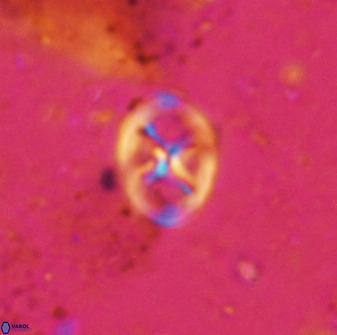
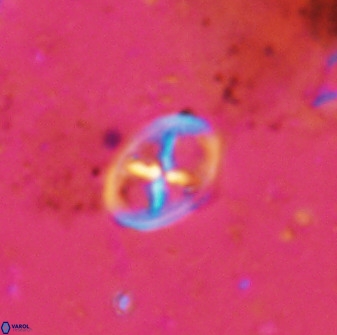
In plan view under crossed polars, the double wall remains in constant extinction, indicating that the optic axis (c‑axis) is oriented perpendicular to the microscope stage. The median row of longitudinal segments displays optical properties distinct from those of the adjacent rows: the median row shows symmetrical extinction (extinction angle = 45°), whereas the bordering rows exhibit parallel extinction (extinction angle = 0°). This contrast in optical behaviour was also recognised by Bramlette & Martini (1964), who noted that “crossbars have calcite orientation different along their central part from that of their borders”.
The type species of Chiastozygus possesses a double wall enclosing a broad central area, which is traversed by a symmetrical cross whose arms are composed of three rows of longitudinal segments. The median row is positioned slightly offset in level relative to the bordering rows, producing a subtle but consistent relief differentiation (see the bright-field photos above).
Aguado, R., Company, M., O'Dogherty, L., Sandoval, J. & Martinez, M. 2022. New insights into the Barremian–lower Aptian calcareous nannofossils of the Mediterranean Tethys: Chronostratigraphic and paleobiogeographic implications. Marine Micropaleontology. 173: 1-24.
Bramlette, M. N. & Martini, E. 1964. The great change in calcareous nannoplankton fossils between the Maastrichtian and Danian. Micropaleontology. 10(2): 291-322.
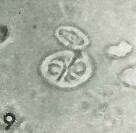
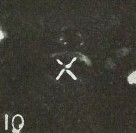
Holotype
Zygodiscus amphipons
Bramlette & Martini, 1964
Late Maastrichtian
Prairie Bluff Formation, Alabama, USA