Conusphaera rothii rothii
Set number: 2957
-
1
-
2
-
3
-
4
-
5
-
6
-
7
-
8
-
9
-
10
-
11
-
12
-
13
-
14
-
15
-
16
-
17
10µm
Set number: 2956
-
1
-
2
-
3
-
4
10µm
Set number: 2955
-
1
-
2
-
3
-
4
10µm
Set number: 2959
-
1
-
2
-
3
-
4
10µm
Set number: 2958
-
1
-
2
-
3
-
4
-
5
-
6
10µm
1-3, b, 4-6
Cretaturbella rothii Thierstein, 1971
The holotype co‑occurs with Cruciellipsis cuvillieri and Lithraphidites bollii, indicating a Hauterivian age.
Large species (> 4.0 μm) of Conusphaera possess a central core with curved, near‑axial segments. The spiralling pattern of these core segments is clearly expressed in side view under the light microscope. In plan view, the species is elliptical, with the strongly curved segments forming a distinctive spiral arrangement.
In side view under crossed polars, the core segments show first‑order greyish‑white interference colours, whereas in plan view they display first‑order whitish‑yellow interference colours.
Conusphaera rothii rothii differs from Conusphaera mexicana mexicana in possessing a distinctly spiralled arrangement of the core segments, in contrast to the non-spiralled configuration characteristic of the latter.
Jakubowski, M., 1986. New calcareous nannofossil taxa from the Lower Cretaceous of the North Sea. INA Newsletter. 8, 38-42.
Thierstein, H. R., 1971. Tentative Lower Cretaceous Calcareous Nannoplankton Zonation. Eclogae Geologicae Helvetiae 64, 459-488.
Holotype
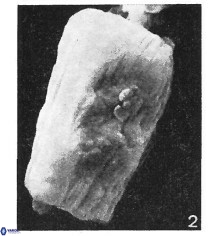
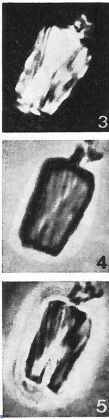
Cretaturbella rothii
Thierstein, 1971
Hauterivian
DSDP Leg 1, Site 4, Blake Bahama Basin, West Atlantic