Calculites obscurus
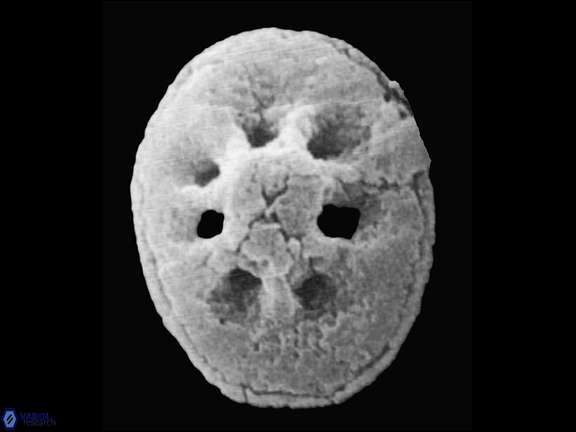
SEM photo of Calculites obscurus from Farhan et al. 1994 (Pl. 1, Fig. 7)
Set number: 2994
-
1
-
2
-
3
-
4
-
5
-
6
-
7
-
8
-
9
-
10
-
11
-
12
-
13
-
14
-
15
10µm
Set number: 2993
-
1
-
2
-
3
-
4
-
5
-
6
-
7
-
8
-
9
-
10
-
11
-
12
-
13
-
14
10µm
Set number: 2992
-
1
-
2
-
3
-
4
-
5
-
6
-
7
-
8
10µm
Set number: 2991
-
1
-
2
-
3
-
4
10µm
Set number: 2990
-
1
-
2
-
3
-
4
-
5
-
6
-
7
10µm
Set number: 2989
-
1
-
2
-
3
-
4
-
5
10µm
Set number: 2988
-
1
-
2
-
3
-
4
10µm
Tetralithus obscurus Deflandre, 1959
Species of Calculites are constructed of a narrow outer wall and four central crystalline blocks that support a solid distal process, elliptical in cross-section. The process is supported by six to seven struts, which produce depressions between adjacent struts. The scanning electron microscope image illustrated in Plate 1, Figure 7, of Farhan et al. (1994) provides the best example of this detailed structure.
In this elliptical holococcolith, two almost right-angled axial crystalline blocks with rounded margins occupy the apex and are separated by two lateral crystalline blocks that are trapezoidal in outline and also have rounded margins. The lateral crystalline blocks meet along the long axis via straight inner margins, often forming an indistinct central axial suture, likely related to the presence of the distal process.
In this holococcolith, in plan view under crossed polars, the outer wall and the crystalline blocks display first-order yellowish-white interference colours, whereas the distal process exhibits second-order reddish-blue interference colours.
Calculites obscurus exhibits parallel extinction (extinction angle 0°) and length-slow (+) elongation in its natural position.
The detailed structure is visible only in well-preserved specimens. Under the light microscope, poorly preserved specimens show only four crystalline blocks in plan view; in such cases, only the suture lines of the axial crystalline blocks, confined to the apex of the holococcolith, are distinct.
The consistent base occurrence of Calculites obscurus is recorded at 85.04 Ma, within the Middle Santonian. Occurrences below this level are only sporadic.
Deflandre, G. 1959. Sur les nannofossiles calcaires et leur systématique. Revue de Micropaléontologie 2: 127-152.
Farhan, A. J., Burnett, J. A., Bown, P. R. & Lord, A. R. 1994. Holococcoliths from the Upper Cretaceous of Alabama and Mississippi (USA). Cahiers de Micropaléontologie. 9: 57-73.
Sissingh, W. 1977. Biostratigraphy of Cretaceous calcareous nannoplankton. Geologie en Mijnbouw. 65(1): 37-65.
Holotype
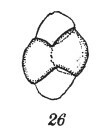
Tetralithus obscurus
Deflandre, 1959
Maastrichtian
Vanves, Seine, France.