Cretarhabdus primus
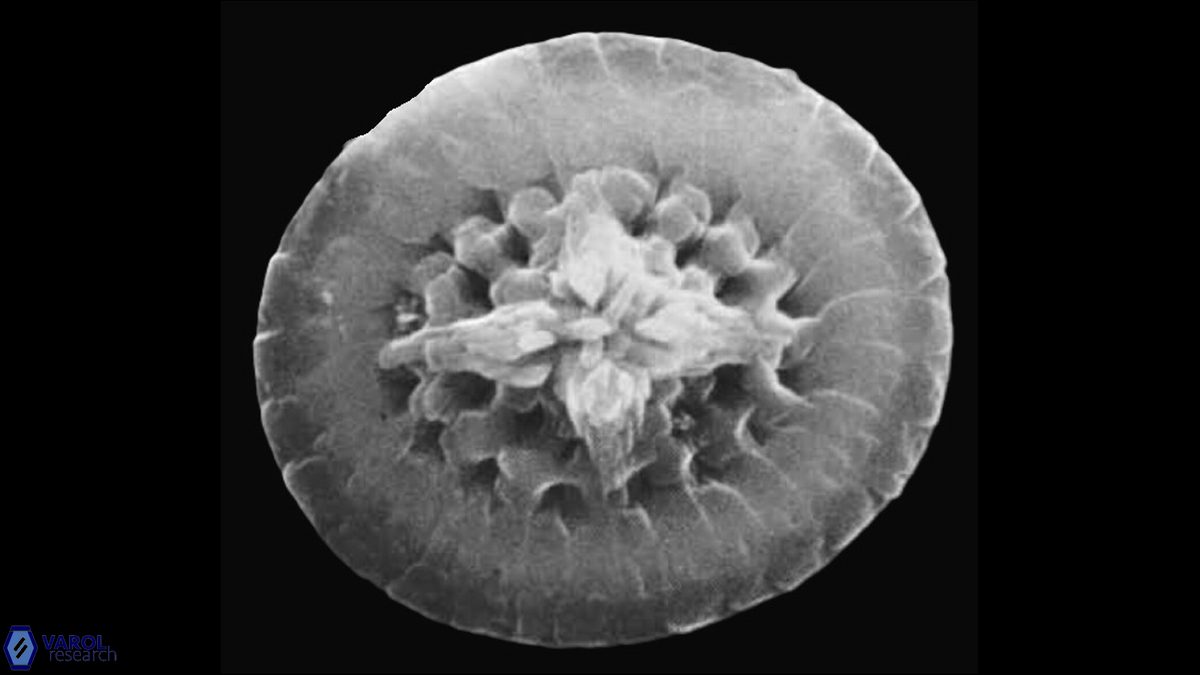
SEM photo of Cretarhabdus primus from Wise & Wind, 1977 (Pl. 69, Fig. 2)
Cretarhabdus primus Black, 1971a
Cretarhabdella spectabilis Black, 1972a
The entire species exhibits first-order, slightly greyish-white interference colours. The pelaga of Cretarhabdus primus exhibits inclined extinction and length-slow (+) elongation in their natural settling position, in plan view under crossed polars.
Species of Cretarhabdus are constructed of cretarhabdid shields and a tube cycle surrounding a large central area, with lateral bars delimiting approximately 16 pores in the outer cycle and an axial cross supporting a distal process.
Black, M. 1971a. Coccoliths of the Speeton Clay and Sutterby Marl. Proceedings of the Yorkshire Geological Society 38: 381-424.
Black, M. 1972a. British Lower Cretaceous Coccoliths. I-Gault Clay (Part 1). Palaeontographical Society Monograph. 126: 1-48.
Wise, S. W. & Wind, F. H. 1977. Mesozoic and Cenozoic calcareous nannofossils recovered by DSDP Leg 36 drilling on the Falkland Plateau, south-west Atlantic sector of the Southern Ocean. Initial Reports of the Deep Sea Drilling Project. 36: 269-491.
Holotype
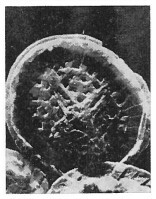
Cretarhabdus primus
Black, 1971a
Berriasian
Speeton Clay at Speeton, England