Heterorhabdus surirellus
Set number: 3126
-
1
-
2
-
3
-
4
-
5
-
6
-
7
-
8
-
9
10µm
Set number: 3128
-
1
-
2
-
3
-
4
-
5
-
6
-
7
-
8
10µm
Set number: 3127
-
1
-
2
-
3
-
4
10µm
Set number: 3125
-
1
-
2
-
3
-
4
10µm
Discolithus surirella Deflandre & Fert, 1954
Cretarhabdus cantianus Black, 1973
Species of Heterorhabdus are constructed of a cretarhabdid pelaga surrounding a large central area spanned by a distinct axial cross that supports a distal process. The inter-cross area is occupied by lateral bars that delimit pores arranged in a single complete concentric cycle. Each quadrant typically contains four pores formed by three lateral bars, a feature characteristic of Heterorhabdus surirellus.
Heterorhabdus surirellus exhibits first-order, slightly greyish-white interference colours. In plan view under crossed polars, the pelaga shows inclined extinction and length-fast (–) elongation.
Black, M. 1973. British Lower Cretaceous Coccoliths. I-Gault Clay (Part 2). Palaeontographical Society Monograph 127: 49-112.
Deflandre, G. & Fert, C. 1954. Observations on current and fossil coccolithophorids in ordinary and electron microscopy. Annales de Paléontologie 40: 115-176.
Holotype
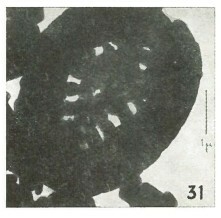
Discolithus surirellus
Deflandre & Fert, 1954
Senonian
Vanves, Seine, France.