Polypodorhabdus sp. 3
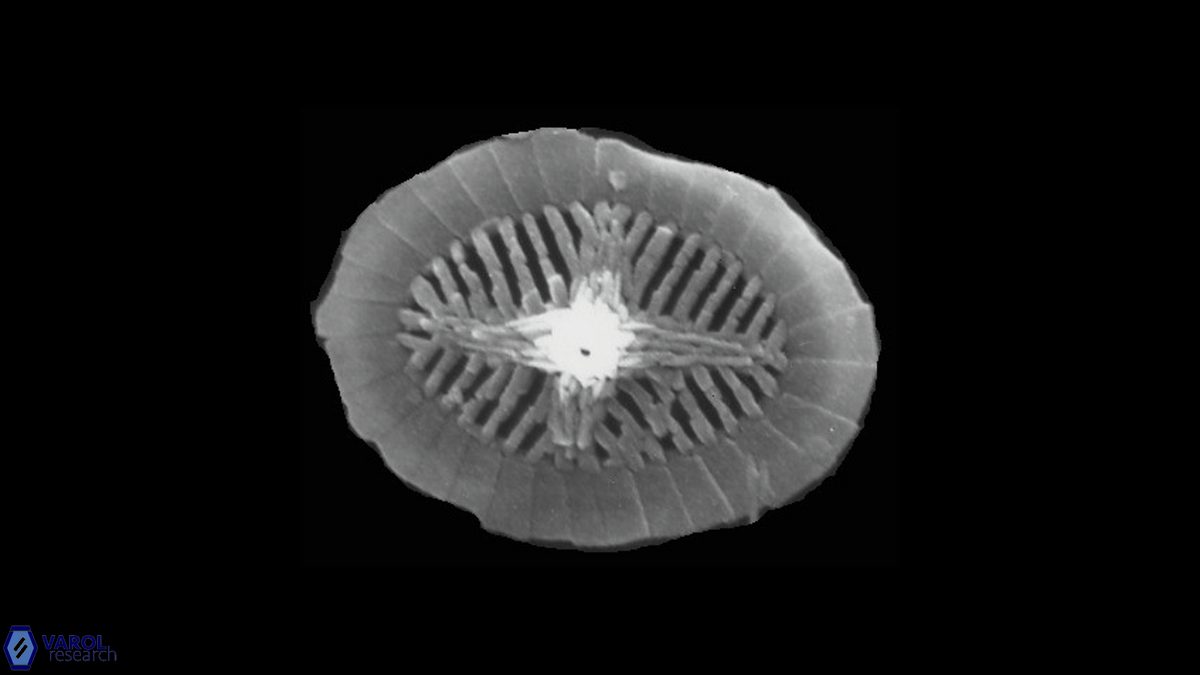
SEM photo of Polypodorhabdus sp. 3 from Bown & Cooper, 1998 (Pl. 4.5, Fig. 18)
Polypodorhabdus sp. 3
Cretarhabdus? delicatus Applegate, Covington & Wise, in Covington & Wise 1987; non-Pl. 16, Fig. 4 (holotype); Pl. 16, Fig.3 (paratype).
The entire species exhibits first-order, slightly greyish-white interference colours. The pelaga of Polypodorhabdus sp. 3 exhibits inclined extinction and length-slow (+) elongation in its natural settling position, as seen in plan view under crossed polars.
Species of Polypodorhabdus are constructed of cretarhabdid shields and a tube cycle surrounding a large central area spanned by an axial cross that supports a distal process. The intercross area is occupied by lateral bars that delimit elongated slits arranged in a single cycle. The number of lateral bars is typically 28 or more, a characteristic feature of Polypodorhabdus sp. 3.
Bown, P. R. & Cooper, M. K. E. 1998. Jurassic. In: Bown, P. R. (Ed.) Calcareous Nannofossil Biostratigraphy. British Micropalaeontological Society Publication Series. 34-85.